How Did the British Come to Rule India? A Simple History for Students

August 22, 2026

11:00 AM
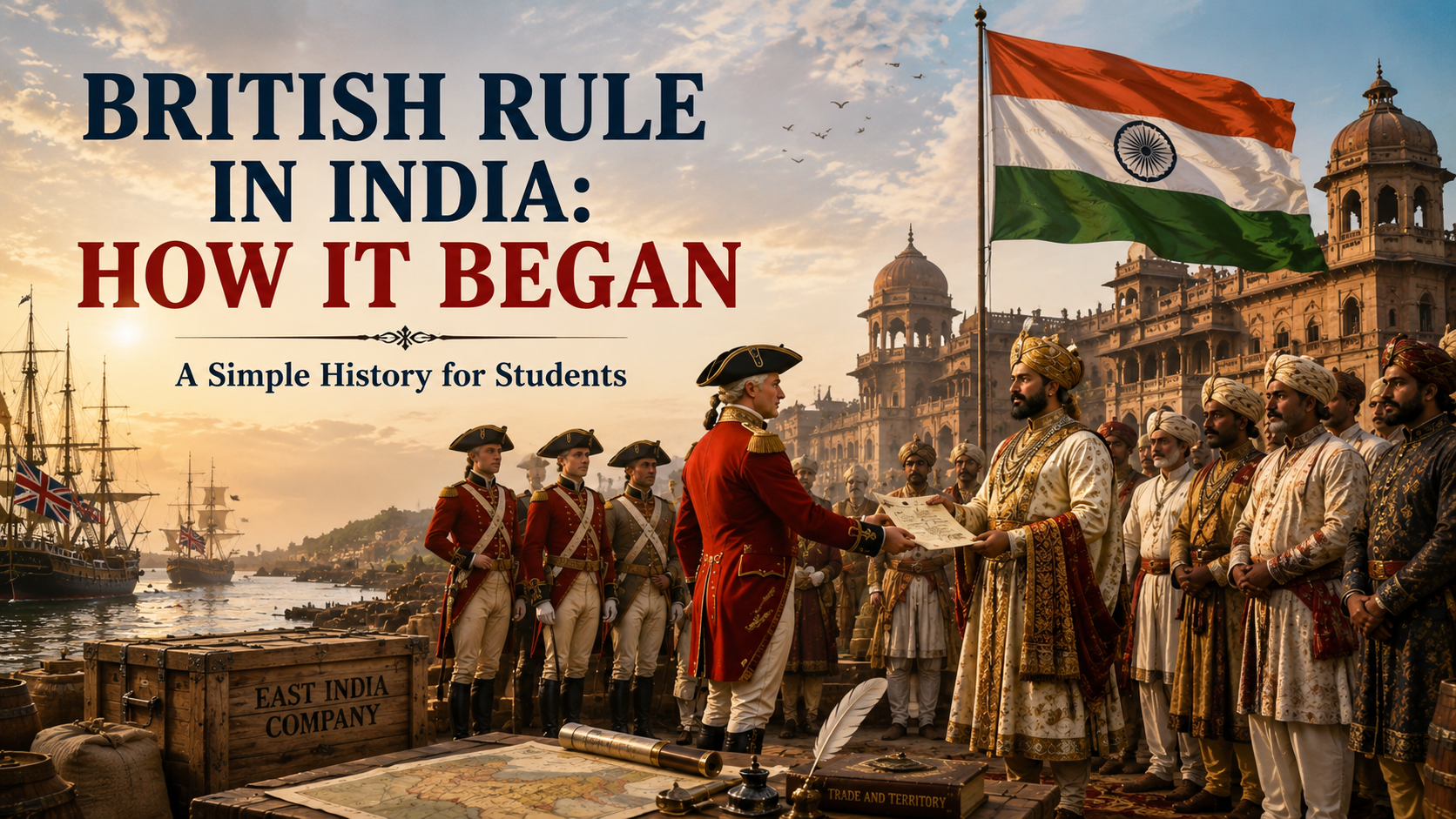
Imagine India hundreds of years ago—not as one country under a single government, but as a land of powerful kingdoms, busy ports, rich markets, skilled artisans, and diverse cultures. Then came traders from a distant island nation who slowly changed the course of Indian history. How did the British come to rule India?
The answer is a story of trade, political rivalry, battles, alliances, and the gradual expansion of British power in India.
It Began with Trade
The British did not initially arrive in India as rulers. In 1600, the English East India Company was established to trade with countries in Asia. The company gradually set up trading centres in places such as Surat, Madras (Chennai), Bombay (Mumbai), and Calcutta (Kolkata).
India was famous for its cotton textiles, spices, silk, indigo, and other valuable goods, making it an important destination for European traders.
At first, the British were merchants—not kings.
From Traders to Political Power
As the Mughal Empire weakened during the 18th century, several regional powers became increasingly independent. Rivalries between kingdoms created opportunities for the East India Company to expand its influence.
The turning point came with the Battle of Plassey in 1757. The Company, led by Robert Clive, defeated the Nawab of Bengal, Siraj-ud-daulah. This victory gave the East India Company significant political and economic influence in Bengal.
The Company was no longer simply interested in buying and selling goods. It was becoming a powerful political force.
How Did British Power Expand?
Over the following decades, the East India Company used a combination of military strength, treaties, alliances, and political strategies to expand its territories. One important policy was the Doctrine of Lapse, associated with Lord Dalhousie. Under this policy, certain princely states could be annexed if their ruler died without a natural male heir. The Company also fought several major wars against Indian powers, including the Mysore Kingdom, the Marathas, and the Sikh Empire.
Step by step, British-controlled territories grew across the Indian subcontinent.
The Impact on India
British expansion had a major impact on Indian society and the economy. Traditional industries, particularly Indian handicrafts and textiles, faced serious challenges as British manufactured goods entered Indian markets. Indian resources and revenues increasingly supported the interests of the East India Company and, later, the British government.
At the same time, new developments such as railways, postal systems, telegraph networks, and modern educational institutions were introduced. However, these developments were largely shaped by colonial economic and administrative interests.
Understanding this history means looking at both the changes introduced during British rule and the inequalities that accompanied them.
From Company Rule to the British Crown
In 1857, a major uprising broke out against Company rule. Often called the Revolt of 1857, it involved soldiers, rulers, civilians, and other groups across several regions. The uprising was eventually suppressed, but it changed the structure of British rule.
In 1858, the British Crown took direct control of India, ending the rule of the East India Company.
India would remain under British colonial rule for nearly another 90 years.
What Can Students Learn from This History?
The story of British rule in India is more than a list of dates and battles. It teaches us about power, leadership, unity, economic independence, resistance, and the importance of understanding our past.
India’s journey from colonial rule to independence was long and difficult. Millions contributed to the freedom movement in different ways, ultimately leading to India’s Independence in 1947.
At Auden School, we believe history becomes meaningful when students look beyond textbooks and understand the people, choices, struggles, and events that shaped our nation.